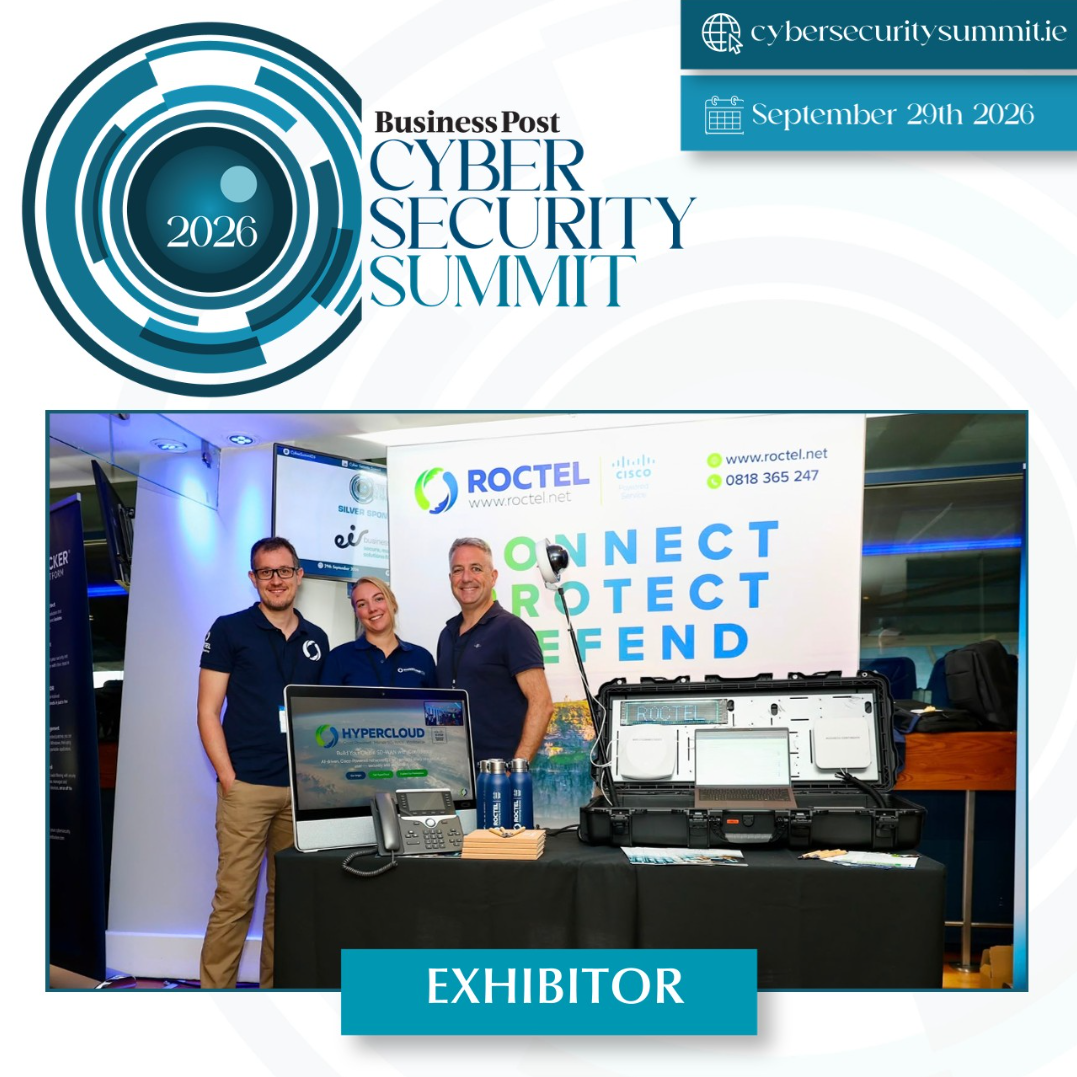
On Tuesday, 29 September 2026, ROCTEL joined cybersecurity leaders, technology specialists, policymakers and industry experts at the Business Post Cyber Security Summit 2026 in Croke Park, Dublin.
Under the theme “Building Cyber Resilience in an Era of Constant Threat,” this year’s Summit explored how organisations can respond to an increasingly complex threat landscape — from AI-driven attacks and ransomware to supply-chain vulnerabilities, regulatory pressure and the protection of critical national infrastructure.
For ROCTEL, it was also an opportunity to meet organisations from across Ireland, discuss the challenges they are seeing first-hand and showcase how secure connectivity and cybersecurity increasingly need to operate as one.
AI is changing both sides of cybersecurity
Artificial intelligence featured heavily throughout the day.
The opening panel, AI, Cybercrime & the Next Wave of Threats, examined how technologies such as deepfakes, automated phishing and increasingly sophisticated AI-assisted attacks are changing the threat landscape.
At the same time, AI is becoming an increasingly important part of defence — helping security teams identify unusual behaviour, analyse huge volumes of information and respond faster to potential threats.
The message was clear: AI is not simply another technology for organisations to adopt. It is changing both how attacks are carried out and how organisations defend themselves.
As AI capabilities continue to develop, visibility, automation and strong security controls will become increasingly important.
Cyber resilience goes beyond cybersecurity
One of the strongest themes throughout the Summit was resilience.
The discussion around critical infrastructure brought together leaders from sectors including healthcare, energy and financial services to look at how organisations can continue operating when disruption occurs.
Cybersecurity is no longer only about preventing an attack.
Organisations need to think about:
This is particularly important as businesses become increasingly dependent on cloud platforms, connected devices, distributed workforces and digital services.
At ROCTEL, this is a principle we continually emphasise: resilience needs to be engineered into the network, not added after something goes wrong.
NIS2: accountability is moving higher up the organisation
Regulation was another major theme.
The Summit included dedicated discussions around NIS2, DORA, GDPR, the Cyber Resilience Act and the EU AI Act, with particular attention given to accountability, governance and what organisations need to demonstrate in practice.
Cybersecurity is becoming a leadership and business governance issue, not simply an IT responsibility.
Organisations need to understand their risks, document their controls, assess their suppliers and demonstrate that appropriate measures are actually operating — rather than relying solely on policies and compliance exercises.
From VPN to Zero Trust
Zero Trust also featured prominently on the technical agenda.
One presentation compared how the same attacker could progress through two organisations using very different access models — a traditional VPN environment versus a Zero Trust Network Access (ZTNA) architecture.
The discussion demonstrated how identity-driven access, application-level segmentation and tighter security controls can limit an attacker's ability to move through an organisation after gaining initial access.
The principle behind Zero Trust remains straightforward:
Never automatically trust. Continuously verify. Limit access to what is actually required.
As organisations operate across more locations, cloud applications and remote environments, that approach is becoming increasingly relevant.
Cybersecurity is increasingly about visibility
Across ransomware, AI, cloud security, supply chains and critical infrastructure, one common theme kept appearing:
You cannot protect what you cannot see.
Knowing what is connected to your network, who has access, how infrastructure is performing and where potential weaknesses exist is becoming fundamental to modern cybersecurity.
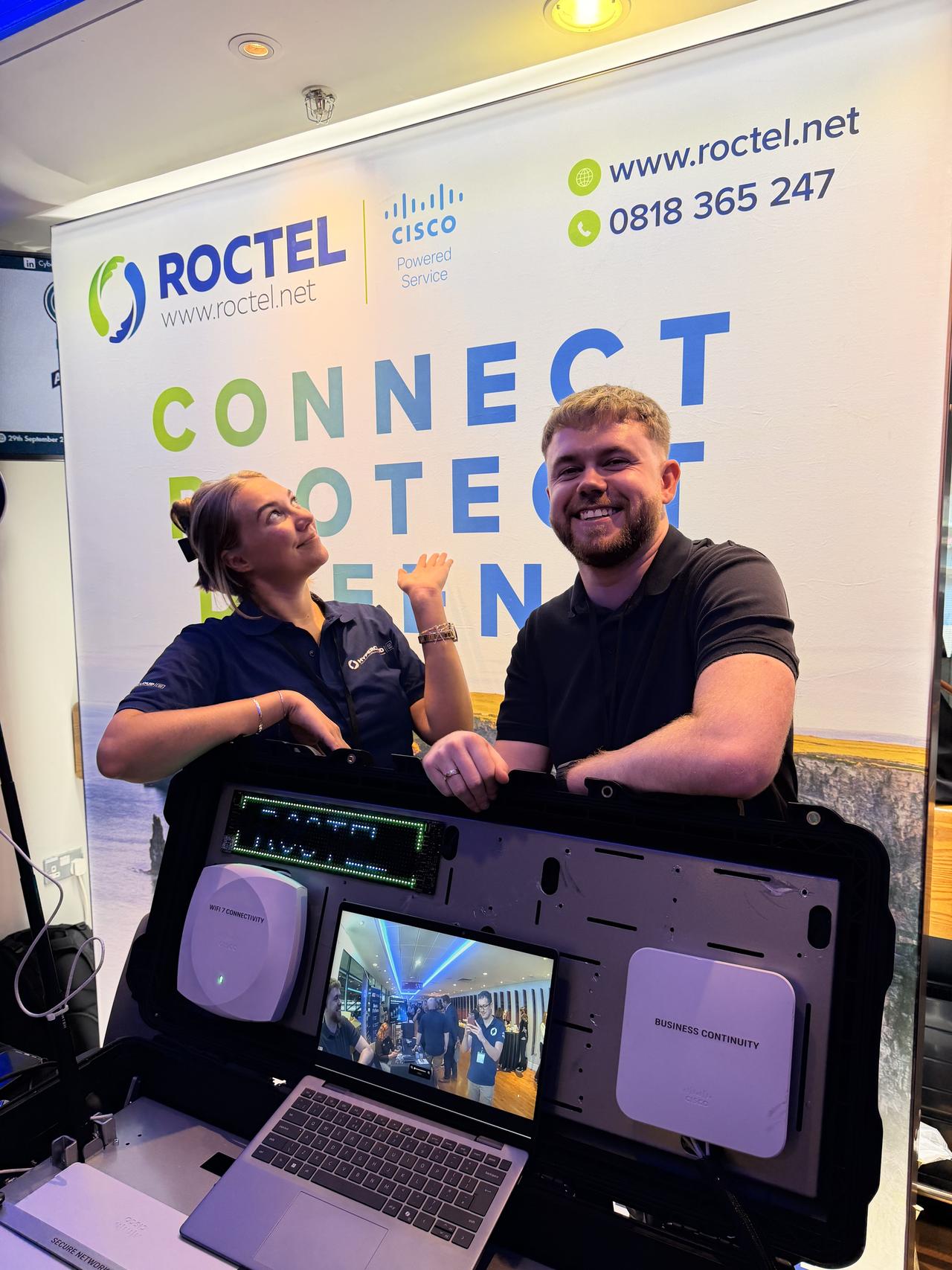
This was particularly relevant at the ROCTEL stand, where we showcased the Cisco Meraki Cloud Experience, giving attendees an opportunity to see cloud-managed networking and security technology in action.
From Wi-Fi 7 and switching to security, sensors and cloud-based management, the technology demonstrated how organisations can gain greater visibility and control across increasingly distributed environments.
Connect. Protect. Defend.
The Cyber Security Summit reinforced something we see every day when working with our customers:
Connectivity and cybersecurity can no longer be treated separately.
The network is where users, applications, devices, cloud services and data come together. Protecting an organisation therefore starts with building infrastructure that is secure, visible and resilient by design.
That is the thinking behind ROCTEL's approach: Connect. Protect. Defend.
From secure managed connectivity and resilient networks to Zero Trust, Cyber Defence and global networking through HyperCloud, ROCTEL helps organisations build and manage infrastructure designed for the way businesses operate today.
A big thank you to the Business Post Cyber Security Summit team, speakers, partners and everyone who stopped by the ROCTEL stand for a conversation.
We came away with plenty to think about — and plenty more to discuss in the months ahead.
Ready to strengthen your network and cybersecurity?
Talk to ROCTEL about building a more secure, resilient and manageable network for your organisation: sales@roctel.net
#ROCTEL #CyberSecurity #CyberSecuritySummit #CyberResilience #CyberDefence #NetworkSecurity #ZeroTrust #NIS2 #ArtificialIntelligence #AI #CriticalInfrastructure #Cisco #CiscoMeraki #SecureConnectivity #ManagedServices #HyperCloud #SeaScan #DigitalResilience #Ireland